
Why the EV Revolution Never Came
How hype and idealism wasted a once in a century opportunity.

In 2023, I started a new job at a company which made critical equipment for electric vehicle (EV) battery manufacturers. At the time, it seemed like everyone in the industry and media was convinced we were in an EV revolution.
Every day, headlines declared the inevitability of an all electric future.
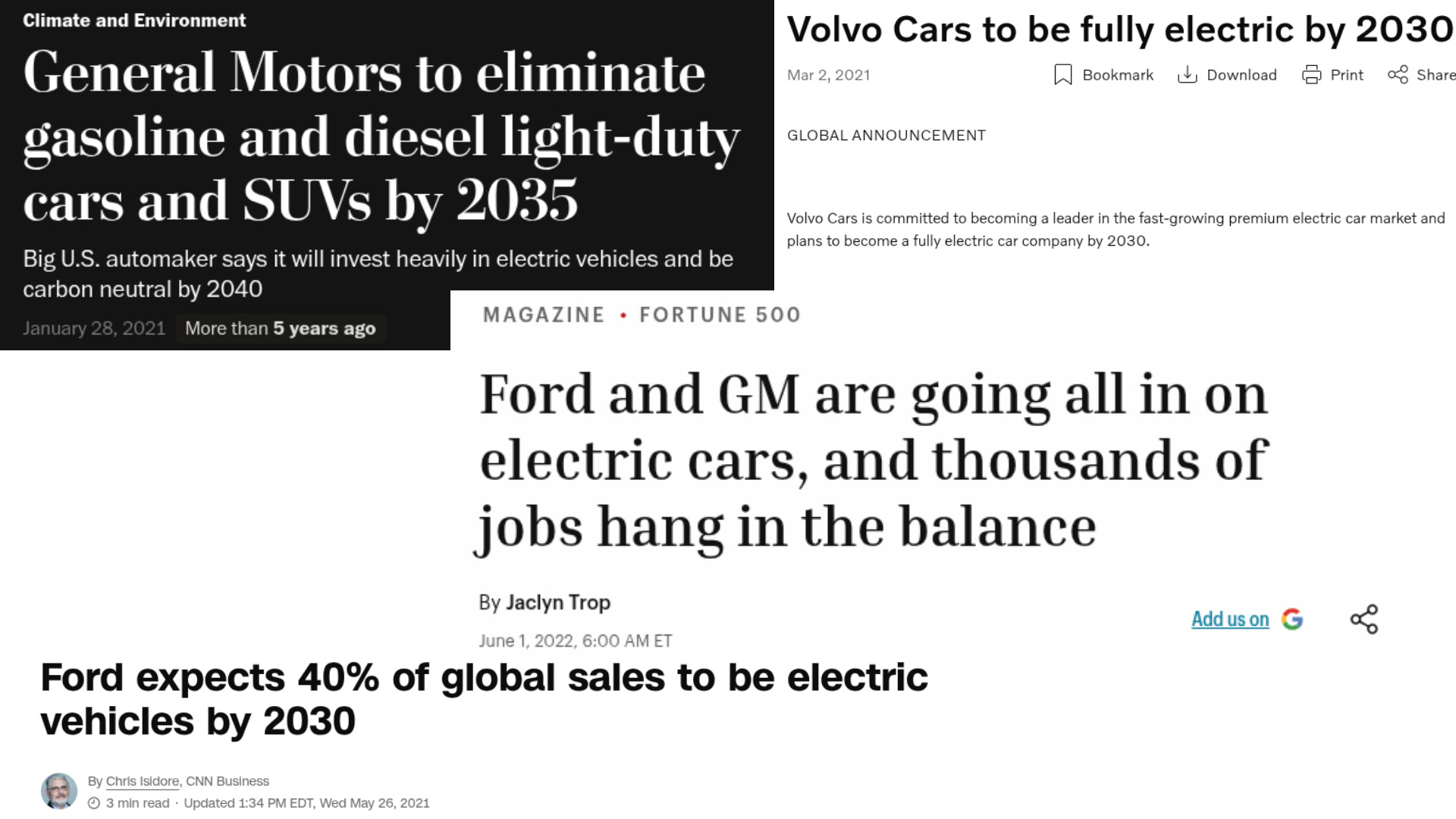
This 2021 quote from then CEO of Volvo Håkan Samuelsson, perfectly encapsulates the industry’s attitude:
“There is no long-term future for cars with an internal combustion engine . . . Instead of investing in a shrinking business, we choose to invest in the future.”
Now here we sit in 2026, four years after Joe Biden signed the Inflation Reduction Act and sixteen years after the federal EV tax credit was first implemented. Despite the massive subsidies and government effort, EVs make up less than 2% of the US light-duty vehicle fleet.1 With the repeal of the EV tax credit, sales have plummeted.2 As of March 2026, EVs make up about 6.6% of new cars sold and are trending down.3
In response automakers across the US are scaling back their EV ambitions. Models have been canceled, staff laid off, and their new battery plants are being repurposed for utility scale energy storage. Even Tesla, the titan of this industry, is now saying its future isn’t in EVs, but autonomous taxis, humanoid robots, and AI.
Globally the picture is somewhat more nuanced, but the exceptions prove the rule. Both China and Europe continue to see EV growth, but adoption is fueled by unique circumstances and massive government intervention.
Between 2009 and 2023, the Chinese government spent over $230.9 billion to support EVs.4 And this doesn’t include billions more in subsidies and aggressive government intervention across the rest of the EV supply chain.5 On top of all this stimulus, Chinese EV makers are locked in a brutal price war that has cost the industry $68 billion so far.6 Needless to say, this kind of environment is not financially sustainable, and would be impossible to replicate anywhere else in the world.
Europe is still seeing steady growth, but again this is primarily due to a combination of aggressive government subsidies, strong regulations, and Chinese exporters chasing profitability outside of China. In places where those incentives have been dialed back or removed, adoption slows down.78 The rest of the world (Southeast Asia, Latin America, Middle East and Africa) lags far behind Europe, China, and the US. In these regions, less than 1% of new cars sold are EVs, and there’s essentially no domestic EV production.
Since I live in the US, my main focus is going to be here. And in the US, we were promised an imminent revolution. What we got was billions of dollars spent, deadlines missed, and ambitions defeated or scaled back. So what happened?
A Pattern of Disappointment
For the past several decades, almost all new “tech” was software. An entire generation of leaders has come of age in a software-centric world, and they’ve developed some irrational beliefs because of this.
Software is eating the world. - Marc Andreessen
You see, software is the opposite of physical technology. Software, once created, has basically zero marginal cost. You can sell infinite copies of the program, but you only had to pay to develop it once. Because software is so easy to adopt and install, it’s prone to explosive and exponential growth. Network effects then lock consumers in, creating immensely profitable monopolies. These natural characteristics of software companies lead to relatively low costs, small physical footprints, and absurdly high profits.
The problems start when people who’ve spent their lives in this environment move into the physical world. The archetype of a tech bro coming into an old, sclerotic industry and disrupting it has become a meme. But it’s usually not successful.
Physical tech is characterized by slow, incremental improvements, low margins, and economies of scale. The rapid iteration common in software companies (move fast, break things) has much higher costs when you’re building physical products. This approach is not possible with hardware, unless you can burn obscene levels of cash. How does one acquire all that cash? Create massive hype and overpromise what your product will do!

This dynamic has created a new pattern with how technologies are adopted by our society. It goes something like this:
An immature technology that’s been slowly advancing for decades starts to reach the cusp of commercial viability. A charismatic founder (almost always with a background in software) creates a new company to commercialize this tech.
The founder’s company will often, but not always deliver meaningful success. Hype starts to build on social media and in influencer circles.
Hype goes mainstream. Journalists, politicians, and CEOs all agree that this tech is the inevitable future and nothing can stop it now!
Legacy companies start to invest vast sums of money to catch up, and politicians pass bills based on the assumption of inevitability.
Right as all this investment comes online, progress with the tech starts to slow down. The early adopters have already bought in, and it’s harder to convince more people to jump on the bandwagon. At the same time legitimate challenges with the new tech emerge, slowing progress and growth.
Further innovation and progress requires massive investments in R&D. Everyone in the industry is faced with having to admit that “this tech is actually harder than we thought”. Going forward, progress will take more time than initially expected, and massive profits are much farther away and not guaranteed.
Instead of leaning into this new reality and making slow, incremental progress, leaders back away from the space to chase the next hyped technology. Billions of dollars are either wasted or repurposed for other less profitable uses.
Sometimes gradual adoption resumes, with a few companies staying in the space and accepting slow, linear growth. Other times the tech is completely abandoned.
Basically, the pattern is this meme:

The biggest issue with this cycle isn’t the end result. Superior technologies will eventually be adopted one way or another. The problem is that this approach to new technology has three incredibly destructive side effects:
It’s profoundly wasteful. Capital and resources are squandered unnecessarily.
It breeds cynicism about technology. It only takes witnessing one or two of these cycles before people start to become jaded. In the worst case, they might start to push back on promising technologies in the future.
It’s an inefficient way to change the world. Think of the old fable of the tortoise and the hare. In the cases where the tech sticks around, the winners are often the ones who pursued slow and steady growth.
What Went Wrong With EVs
EVs are the perfect case study of the pattern in action.
In the early/mid 2000s, lithium-ion batteries started to reach viability for commercial EVs. A company called Tesla was founded in 2003 to exploit these advances, and Elon Musk joined shortly after. For years mainstream journalists, politicians, and companies dismissed Tesla and EVs as a novelty. During this time, Elon cultivated a brand as a leader of companies that will make a Utopian future a reality. He usually overpromised, but critically Tesla did achieve meaningful success.
In 2008, the first EV tax credit was passed, and was implemented in 2010. That same year, Tesla received a government loan and had its IPO. At this point, Elon had developed a following among influencers who repeated and amplified his hype, which drove massive investment into Tesla. Tesla used that cash to build out manufacturing at scale.
In 2016 Tesla built its first battery gigafactory. EV hype went mainstream, and everyone recognized that EVs were the future. In 2018, Tesla hit its EV tax credit cap and began lobbying heavily for an extension.
After COVID 19, free money was already driving investment into hyped areas, but the 2022 Inflation Reduction Act (IRA) was set to provide a tsunami of money. The rest of the auto industry joined Tesla in lobbying for an EV tax credit extension to be included in the bill. The law passed with massive incentives for manufacturers, and helped further boost the existing hype cycle. Legacy automakers spent billions and promised to electrify their entire lineups by early 2030s.
Most people believed that lithium-ion batteries were good enough, and that increasing scale would reduce costs. Consequently, most of the IRA money went to building out manufacturing capacity and infrastructure, not improving battery technology. But at this point, most of the early adopters had already bought EVs. It soon became clear that battery technology still had major limitations, which made EVs at any price unappealing to large parts of the market. To maintain aggressive growth, large and expensive advancements in the underlying battery technology would be required.
This brings us roughly to the present. Faced with the technical limitations of lithium-ion batteries, most legacy manufacturers are pulling back and even Tesla has moved on to other over-hyped areas (autonomous vehicles, humanoid robots) to justify their company’s massively overvalued stock price.
What was the end result of the hundreds of billions in private and public spending? 2024 is the most recent data we have, but based on those numbers, all of this spending took EVs from about 1% of the existing vehicle fleet in 2022, to 1.4% in 2024.
EVs continue to meet the needs of a small part of the market, and will likely keep growing slowly. But this wasn’t a revolution that justified billions in private and government spending. A quick look at some numbers could have told you that this plan was doomed to fail from the start.
Why EV Adoption is Stalling
A real EV revolution in the US is probably impossible until battery technology improves significantly.
Current EV models can be competitive, but only in countries where there’s some combination of strict regulations for vehicle emissions, high fuel prices, low electricity costs, robust charging infrastructure, and subsidies for EVs. Right now, America doesn’t meet any of those conditions.
We also have a unique car culture. The first commercially viable gasoline-powered cars were built here, and Henry Ford pioneered mass automobile production and affordable cars for the middle class. The US has the world’s largest road network (4.1 million miles) and by far the most developed interstate highway system. Americans are accustomed to driving long distances, and the American road trip is ingrained into our culture. Our refueling infrastructure for gas and diesel is robust, while charging infrastructure is limited or nonexistent in most places.
In this environment, EVs lose.
To prove the point we can run a basic comparison between different types of cars consumers can choose from.
For this comparison, we’ll put Tesla up against Toyota and Nissan.
Tesla is basically the only major company that has (had?) a viable and self supporting EV business. Tesla EVs generally lead the industry on cost and quality. Tesla also has by far the most competitive charging infrastructure.
Toyota is one of the more expensive vehicle manufacturers, but has arguably the best hybrid technology. They’re also a leader in quality.
Nissan has the cheapest EV currently available in the US, the Nissan Leaf. While the Leaf’s quality is much lower than Tesla’s or Toyota’s, it’s a good control.
Charging:
Fast charging takes 30 minutes to 1 hour for 80% charge. Ultra fast charging is only available in select locations from specific manufacturers, and it still takes 15-25 minutes to reach 80% charge. Different brands use different systems, and they aren’t always compatible with each other, especially for fast charging.
The biggest problem with charging is the lack of infrastructure. Installing a charger at home costs several thousand dollars, and may be impossible if you don’t own a home.
Public charging is a huge problem. There are over 150,000 gas stations in America, all of which were built by the private sector and have been self sustaining businesses since day one. The story with EV charging is basically the opposite. EV chargers (especially in lower traffic areas outside of urban cores) require government subsidization to be built, and are usually underutilized and unprofitable. At many stations, it costs more on a per mile basis to charge an EV than refill a gas car. Worse still, even with subsidies, a significant portion of public charging stations won’t be able to close that cost gap.9
This means that for a large portion of America’s road system, EV chargers will either never be built, or will need to be subsidized by taxpayers indefinitely.
Range:
Range is probably the most talked about issue with EVs, and sometimes the problem is exaggerated. Actual range heavily depends on the model, manufacturer, driving conditions, and habits of the owner. But the simple fact is that EVs have significantly less range than gas or hybrid vehicles.
Here’s an example of ranges for new 2026 car models:
Tesla Model 3 - 363 miles
Nissan Leaf S+ - 303 miles
Toyota Corolla LE (gasoline) - 462 miles
Toyota Corolla LE Hybrid - 565 miles
This comparison is also being generous to EVs by only comparing smaller, passenger vehicles. The range problem gets much worse when you scale up vehicle size and required performance. The now discontinued Ford F-150 Lightning Extended Range model had a max range of 320 miles. The Tesla Cybertruck has a similar max range of 325 miles. Compare this to an all-gas F-150’s max range of 648 miles!
Now does your average American commuter need more than 300 miles of range for their daily driving? Mostly no, at least not in their daily lives. But these range considerations are under ideal conditions, which brings us to our next point.
Performance:
We have to be careful when we talk about EV performance. There’s absolutely no question that electric motors are superior to internal combustion engines. This has been true since both technologies were invented more than a century ago. Electric motors have fewer moving parts, require less maintenance, offer greater power/torque, and are cheaper than internal combustion engines.
The problem has always been with the fundamental limitations of lithium-ion batteries.
Battery performance takes a significant hit when conditions aren’t ideal. This shows up most strongly in vehicle range. I was being generous to EV manufacturers when citing their stated ranges, but it’s well documented that range claims by manufacturers are very optimistic. EVs are at their best for city driving on level roads and mild days.
Driving in cold weather on hilly highways can reduce an EV’s range by at least half.
Hot weather also has an impact due to AC usage, but it’s lower at about 17%.
And our range stats are also ignoring performance while towing or hauling. This pro-EV publication admits that towing a heavy load would cut the F-150 Lightning’s range in half.
Even if many EV performance issues don’t show up in daily life for most people, they become a serious problem in edge case scenarios. These rare and unusual situations are where EVs simply fail. They just aren’t up to the job. EV advocates will claim that people focus too much on edge cases when talking about EVs, but that’s actually where performance matters most. People care because something that can’t perform in edge cases loses a disproportionate amount of its overall value.
Imagine you’re a construction worker using your pickup truck to haul your tools and trailer to a job site on a 15-degree winter day. There’s no power on site, and definitely no EV charger. The site is 40 miles from your house, and you’ll be taking your breaks inside of your truck with the heat blasting. With your trailer and tools, you’re looking at 150 miles of range if you’re lucky. Under these conditions, you’ll just barely make it home before your battery hits zero, and that’s assuming you don’t need to make any trips to the nearest Home Depot.
At my old job, I watched this exact situation play out. The higher ups and corporate folks thought it would be cool to buy an F-150 Lightning for our service technicians. After all, Ford’s battery factories were giving us a lot of business, and our company had ambitious net zero goals. So we got a heavily discounted Lightning (dealers were having a hard time finding buyers even in 2023) and we spent thousands of dollars converting the truck’s bed into tool storage.
Our service guys would usually drive hundreds of miles in a day to facilities that didn’t have charging infrastructure. They drove it once, realized it was totally impractical, and left it sitting in the parking lot untouched for months. The only time that vehicle moved was when the head of service drove it home for fun every couple of weeks.
For people who already live in urban areas and don’t demand a lot from their vehicles, edge cases might not be a huge concern. But the majority of the market doesn’t fit that description, and to them performance matters.
Cost:
Cost is the single most important barrier to EV adoption. Here’s a simple truth: EVs are significantly more expensive to purchase than their gas or hybrid counterparts. That was true even when we had a generous EV tax credit, and it’s even more true now.
Let’s compare our example cars again:
Tesla Model 3 - $38,630
Nissan Leaf S+ - $31,485
Toyota Corolla LE (gasoline) - $24,120
Toyota Corolla LE Hybrid - $25,970
Those are online sticker prices for base models that include all destination charges.
A consumer looking at a hybrid Corolla vs Model 3 would be paying a little over $12,000 more for a vehicle that has worse range, worse performance, and less access to refueling/charging infrastructure. For the Leaf, it’s a $5,500 premium. This price also doesn’t include the cost of installing a home charger. On the low end, a home charger for both would cost $2,000 ($450 for wall connector, $1,550 in electrician labor (assuming no service upgrades are required).
So where’s the value for the consumer? EV advocates claim it lies in fuel and maintenance savings. And once again, there’s a nugget of truth here. Internal combustion engines are complex pieces of machinery that require more maintenance than the elegant electric motor. They also burn gas, which is more expensive than electricity on a per mile basis.
So how do those numbers pencil out, and do they justify a $5k+ premium price?
Total luxury EV cost premium: $14,000
Total budget EV premium: $7,500
Let’s do some back of the napkin math.
Comparing fuel costs is highly dependent on location, since electricity prices vary dramatically. To keep things fair, we’ll use the 2024-2025 US average price of $0.18 per kilowatt hour of electricity, and $3.30 per gallon of gasoline.
It’s important to note that my price of electricity here is probably way lower than it should be. $0.18 is the average price for residential electricity. Fast charging at public stations is going to cost you double or triple.
According to 2023 government stats, the average American drives approximately 13,662 miles per year. 10
According to EPA data, a 2026 Tesla Model 3 uses 0.240 kilowatt hours per mile traveled. A Nissan Leaf uses 0.30 kilowatt hours per mile.
For the hybrid Corolla, we just do: 1/50mpg = .0020 gallons of gas per mile traveled.
To get our fuel/electricity cost per mile we need to do a few more calculations.
Calculations:
Model 3: 0.240 x $0.18 = $0.0432
Leaf S+: 0.30 x $0.18 = $0.054
Hybrid Corolla: 0.0020 x $3.30 = $0.066
Now we have our costs per mile!
Model 3: $0.043 per mile
Leaf S+: $0.054
Hybrid Corolla: $0.066 per mile
So given those costs, how much will an average American driver spend on electricity or fuel per year with these vehicles?
Model 3 annual electricity cost = $587.47
Leaf S+ annual electricity cost = $737.75
Hybrid Corolla annual gasoline cost = $901.70
So by owning a Model 3 and only charging your EV at home, you’re saving a grand total of $311.49 per year in fuel costs. With a Leaf it’s $164 per year in savings. And if you do most of your charging at public stations, your savings could be completely eliminated. If you don’t have a home charger at all, then an EV would cost more to drive than a gas or hybrid vehicle. 1112
In full disclosure, I didn’t run these calculations until after I started writing this article. I knew the difference would be smaller than what people thought, but I’m shocked!
If you’re relying on fuel savings alone to justify an EV purchase, it would take 45 years before you were paid back for your investment!
If you want to run these comparisons or check my math yourself, the US Department of Energy has a cool website you can use here.
But what about maintenance costs? The US Department of Energy published a good report on the subject, so we’ll use their data. For some reason, you can’t find the report on the DOE site anymore. You can still access the PDF through this article from Yale.
Maintenance Costs Per Mile
Electric vehicle: $0.06
Gasoline-powered vehicle: $0.10
Hybrid costs are basically the same as gas, so with an EV, you’re saving approximately 4 cents per mile in maintenance costs. Using our yearly miles driven, that adds up to:
Electric vehicle annual maintenance costs: $819.72
Gasoline-powered vehicle annual maintenance costs: $1,366.20
If you own an EV, you’re saving $546.48 per year in maintenance costs, which is significantly more than your fuel savings. Now before someone yells at me, I’d like to put in a disclaimer that maintenance costs vary even more than fuel costs, and are unevenly distributed over a vehicle’s service life. It also depends heavily on the quality of vehicle itself and the manufacturer.
You’re not spending anywhere near $1,366 a year for the first 5-10 years of a Toyota’s life. The only additional cost you’d be spending vs an EV would be oil changes, air filters, and maybe some other fluid and belt changes when you get closer to 100,000 miles. After year ten, maintenance costs definitely start to rise, but at the same time your EV’s battery has only about 76% of its original capacity. But to keep things consistent we’ll stick with the government stats.
Once we factor in maintenance costs, the payback period for the “EV premium” drops to a little over 16 years.
The fascinating thing about this payback period is that it has almost nothing to do with a particular manufacturer or purchase price. The fuel and maintenance savings you see with EVs are roughly proportional across models, so the payback period stays roughly the same, regardless of purchase price.
According to the best data I can find, the average age of American passenger vehicles on the road is about 12.8 years. This data is somewhat skewed though as it’s missing 2017-2021, and pre-2016 the average age was closer to 10 years.
Average age for scrapping of vehicles was harder to find, but according to this study it’s 17.6 years. That sounds about right to me, but even if we were generous and said your EV lasted for 20 years, you would have spent a lot of money up front for a few years of relatively small savings at the end of your vehicle’s life.
A Path That Would Have Led to Success
I consider myself a somewhat radical environmentalist, but I understand that real progress requires pragmatism. While I personally don’t like the high-tech style and design choices of most EV models, I want to see emissions from transportation decrease. That’s why I’m so frustrated with how this issue has been approached.
Rather than taking the pragmatic and slower path that would have led to actual success in the long run, we had an unholy alliance of:
Idealistic environmentalists who wouldn’t accept a compromise
Weak politicians who took the path of least resistance
Auto executives who were simultaneously deluded by hype and incentivized by free money to go all-in on an immature technology
Predictably, this ended poorly.
In order for mass market adoption, a new technology can’t be equivalent to the status quo. It has to be objectively superior in almost every way. EVs have come a very long way from their niche beginnings, but as demonstrated, they aren’t superior to the other alternatives. At best, they can come close in some areas, and might result in a net savings of a few hundred dollars after 12-16 years of ownership. It takes massive government intervention to even begin to close this gap.
Obviously, EVs currently meet the needs of many drivers. If you’re some combination of affluent, urban, don’t drive long distances regularly, live in a mild climate, and/or have access to cheap/free electricity, then an EV makes sense. This demographic may make up a small portion of the market, but they aren’t the majority.
This was even more true when we look all the way back to 2010 when the EV tax credit was first implemented. The purpose of that tax credit was to jump start demand by subsidizing early adopters, then phasing out as manufacturers met their caps on EV sales. The (flawed) assumption was that EVs would be competitive by the time the caps were reached. While this credit did also apply to plug in hybrids, it left traditional hybrids out in the cold.
This was one of the greatest environmental missed opportunities of the past several decades.
Worse still, it was repeated in 2022 with the Inflation Reduction Act.
Traditional hybrids were and are the best value on the market.
They offer most of the benefits of EVs, and none of the drawbacks.
They have more range than pure EVs or gas powered vehicles.
They aren’t dependent on charging infrastructure.
They don’t have the performance limitations of EVs in edge cases.
They capture most of the energy gas powered vehicles waste (regenerative braking and electric power at slow speeds).
They take advantage of places where gas engines are most efficient and EVs aren’t, like the open highway.
They gradually teach tech skeptics and late adopters how to use technologies that are central to pure EVs.
Most critically, traditional hybrids sell at only a small premium compared to their purely gas counterparts! A hybrid Corolla is less than $2,000 more than the gas version and doesn’t need a charger installed at your house. Unlike with most EVs, the fuel savings alone pay for this premium in under 5 years.
Comparing a new Toyota Corolla gas vs hybrid model shows that the hybrid costs would reduce fuel consumption (and thus emissions), by about 30%. And if you were switching from an older vehicle that reduction could be 50% or more!
I’ve lived this myself. In 2024 I switched from a 2006 Honda CRV to new hybrid Ford Maverick small pickup truck. I bought the base model and paid a $1,500 upcharge for the hybrid power train. I try to maximize fuel efficiency with my driving habits, so my CRV was getting around 25 mpg combined. My Maverick does 40 MPG in the winter (damn snow tires) and routinely gets above 50 mpg in the other seasons. I’ve tracked all my spending for years, and I can confirm that my annual gas bill was cut in half! The hybrid power train paid for itself in 16 months and my emissions from driving are 50% lower.
Now imagine if the EV tax credit applied to vehicles like the hybrid Corolla or Maverick. The credit barely succeeded in making EVs only somewhat more expensive than their gas powered counterparts. But it would have made traditional hybrids thousands of dollars CHEAPER than their gas powered twins. Traditional hybrid sales have been increasing organically for years without any subsidies. With a tax credit in 2010, or even 2022, hybrids would be dominating new vehicle sales today.
Instead, we collectively fell for the toxic combination of hype, excessive faith in new technologies, and environmental idealism. EVs weren’t ready for mass adoption in the US back then, and arguably, they still aren’t now. It was never a matter of scaling up to reduce costs. To become superior to existing alternatives, EVs are going to need some major technical breakthroughs in battery technology.
Solid-state, or maybe graphene batteries can offer this, but they’re still experimental. They also cost much more than standard lithium-ion batteries, and it will take even more innovation to make them cheaper than today’s hybrids or EVs.
I have no doubt that we’ll get to a fully electric fleet eventually. But it will likely take at least a decade to further develop and commercialize new battery technology, and longer still for costs to drop.
If we had gone all in on traditional hybrids back in 2010, it would have seemed like we were taking longer to reach net zero, and locking in dependence on fossil fuels. But the opposite is true. We could have cut our transportation emissions by at least half, while directing taxpayer dollars to basic research in key battery technologies. If advanced batteries were ready for adoption by now, then we really would be in an EV revolution.
Of course, the past is the past, but we don’t have to make the same mistakes again. We can learn from the pattern of tech hype and disappointment, both for EVs and for other cutting-edge technologies.
Public money should be directed to R&D on breakthrough battery technologies, not subsidizing the private sector. While we wait for battery technology to catch up, we can still juice consumer demand with tax credits or subsidies, but the most cost-effective way to do this would be to focus on traditional hybrids first.
This would dramatically reduce emissions without requiring any major changes to infrastructure. It would meaningfully reduce the cost of living for millions of Americans, and pave the way for an all electric tomorrow.
https://www.eia.gov/todayinenergy/detail.php?id=67144
https://caredge.com/guides/electric-vehicle-market-share-and-sales
https://www.anl.gov/esia/light-duty-electric-drive-vehicles-monthly-sales-updates
https://www.csis.org/blogs/trustee-china-hand/chinese-ev-dilemma-subsidized-yet-striking
https://sccei.fsi.stanford.edu/china-briefs/its-not-just-subsidies-how-chinas-ev-battery-firms-learned-their-way-dominance
https://fortune.com/2026/02/12/china-car-sales-deflation-price-war-passenger-sales-plumment-nearly-20-percent-january/
https://www.iea.org/reports/global-ev-outlook-2025/trends-in-electric-car-markets-2
https://www.carscoops.com/2025/01/ev-sales-in-germany-plunge-over-27-in-2024-after-subsidies-were-scrapped/
https://www.sciencedirect.com/science/article/pii/S2666792425000514
https://www.evinfrastructurenews.com/ev-networks/average-national-us-fast-charging-ev-price-increases-q3-2025
https://www.kbb.com/car-advice/how-much-does-it-cost-to-charge-an-ev/